How to write a communications strategy – that also works for fundraising, marketing, etc.
Keeping strategy simple

The steps to a clear communications (or other flavour) of strategy
It can feel daunting when faced with writing a communications, fundraising, marketing or other flavour of strategy. But we are big fans of keeping strategy writing simple and visual. Particularly for smaller organisations where most of your energies and time is focussed on frontline delivery.
Understanding that there are logical steps to putting a strategy together can help it feel less daunting and help you to understand what you might already have in place to build on.
Free guide to writing a communications strategy
We have put together a free guide to writing a communications strategy. It was originally produced for a training session with CharityComms so it includes an example of a charity comms strategy. But you can use the steps and approaches to write fundraising, marketing, services or any other strategy covering any area of your organisation’s work. We’ve even used this approach to write whole organisational strategies.
Download our free guide to strategy writing here.
Strategy on a page
You will need to collate the content you gather from your audit and analysis, but when it comes to writing your strategy we suggest trying to fit it onto one page. Using the structure of a logic model or theory of change, you can set out the outcomes (or changes) you want to make. Then think about how you might measure these changes. And the activities and resources needed to achieve them. This visual approach means your strategy is really easy for everyone to understand. It clearly sets out the priorities and the steps needed to deliver them.
Download our free strategy on a page template with examples here. This one is an integrated fundraising and communications strategy but you can adapt it to fit your needs.
We hope you find these resources useful. Let us know what you think and you’ll find more on using the theory of change approach to communications strategies in this article.
Researching gaming and streaming for Mind
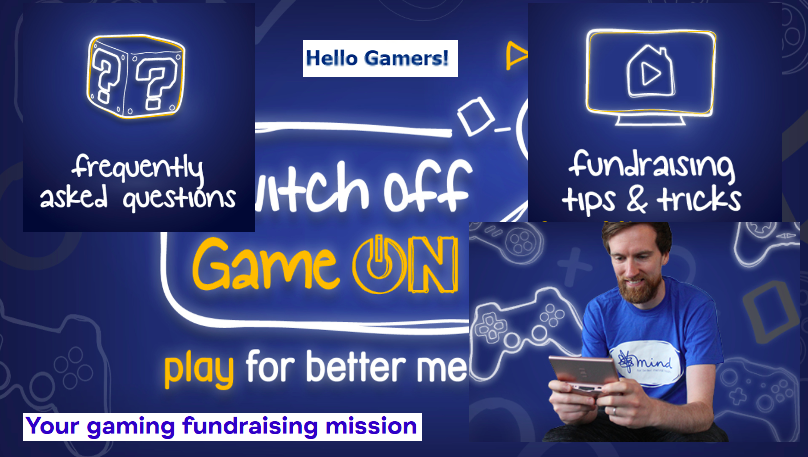
Can we use gaming and streaming to grow fundraising and help reach our strategic audiences?
We are at the early stages of this research project for Mind but it is proving really interesting. Working with Emily Hayes from Semiotics for Brands, we have gone from curious but confused to engaged and excited in a very short space of time.
It is the first time we have looked into how charities are using gaming and streaming. I’ve been having fascinating conversations with other charities who are experimenting and successfully fundraising in this space. Here are a few of the headlines I have learnt so far:
- The gaming and streaming industry is worth more than the film, TV and music industries combined. I’ll leave that to sink in for a bit.
- The average age of people gaming is 31. The gender split is pretty even. We are not talking about teenage boys isolated in their bedrooms.
- Many charity audiences are already on the platforms. You can go to where they are rather than investing in acquisition promotions to get them to come to you.
Basic fundraising 101 works
A clear emerging theme is that successful engagement and fundraising using gaming and streaming strongly aligns with fundraising on other channels and with other audiences. There is nothing special or mysterious about using these channels to raise money and talk about your cause. The principles of fundraising work.
If you want people to fundraise while gaming then you need to provide them with guidelines and branded assets which they can share with family and friends to support their fundraising.
If you run a mass participation event like a timed stream or a virtual run, then you need to use the same approaches to attracting supporters and stewarding them.
If you want to work with an existing streamer who has a connection to your cause then influencer marketing and major donor stewardship principles apply.
Getting started in gaming and streaming
My 16-year-old son, Gus, earned his first Red Pencil freelance fee by writing 2 pages on the difference between gaming and streaming with links to the content I should view. It was jolly useful.
In the absence of a Gus, here are a couple of links that helped take me from curious and confused to excited and engaged.
Charity Digital podcast on gaming and streaming
Giant Digital event on gaming and streaming
If you’d like to stay in touch or have ideas and insights to share on this topic then I would love to hear from you. Please reach out and get in touch.
Rebranding Lia’s Wings to celebrate the life of a special young girl
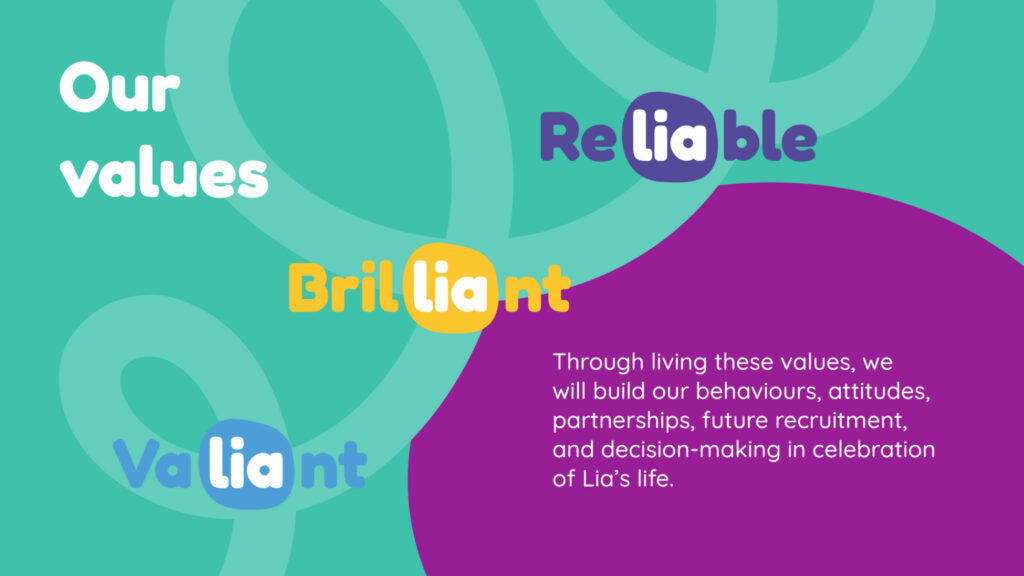
This rebrand was unusual.
It was driven by the tragic death of a very special young girl. Emilia, or Lia as she preferred to be called, is the daughter of two trustees at Lucy Air Ambulance for Children who died suddenly last September. She was five.
Her parents, Patrick and Melissa Schoennagel, wanted to channel their love for their daughter into something positive. To build a lasting legacy in her name. They wanted to do this for the charity to which their family and Lia were committed. They have pledged to transform this small charity’s future. To fly more babies and children needing specialist hospital care in Lia’s name, and grow the support offered to families in the weeks, months and years that follow a hospital air transfer.
The rebrand brief
When Helen Holden of Make Create and I were commissioned to take on this special project, the trustees already had a name in mind, Lia’s Wings.
Our brief was to develop a new verbal and visual identity to celebrate Lia’s life and support the ambitions of this small charity. We needed to do this by understanding what the charity means to people who had been close to and benefited from the previous 12 years’ work of Lucy Air Ambulance for Children. “My son survived because of the medical care he received. We thrived as a family because of the team at Lucy,” said Alex, one of the mums we spoke to. We wrote her words into the new purpose statement.
The values break through
As always, Helen and I started with the values. We had an idea. Lia’s name is in several words. Could we put Lia into the very heart of the charity’s values? In a creative workshop with the staff team, we realised the answer to this was, ‘yes’. Valiant, reliable, and brilliant are the values from which we built the brand.
From the values and with a clear purpose set out, Helen developed a new visual identity. The new logo features a motif to represent the wings of the planes and the flights that Lia’s legacy will enable. It’s the turning of the pages to Lia’s Wings’ future. There are three sections to the motif representing the three values.
The colours also reflect Lia. The main colour palette includes her favourite colour, blue, with purple and yellow complementing and enhancing the range of colours.
When we asked people how it made them feel, they said:
“I love the new name. What a great legacy for Lia. I would absolutely have wanted to do the same if we had been in that position.” Debbie, Jackson’s mum
“It’s such a versatile motif – it could be a wing, a butterfly, an opening book, and the beginning of a story. It gives this charity the space to grow.” Clare, Advanced Neonatal Nurse
Their ambitions for growing
The new brand launches on Monday 24 April and the Schoennagel family are aiming to more than double the annual turnover of this c. £300,000 charity in Lia’s name. The growth in income will allow Lia’s Wings to:
- Fund more life-changing air transfers,
- Expand the family care services,
- Provide specialist training for more nurses and doctors to care for babies and children during air transfers, and
- Develop their partnership with the NHS.
Read the full story and see the new brand in context visit www.lias-wings.org.uk and get in touch if you want to talk about your charity branding.
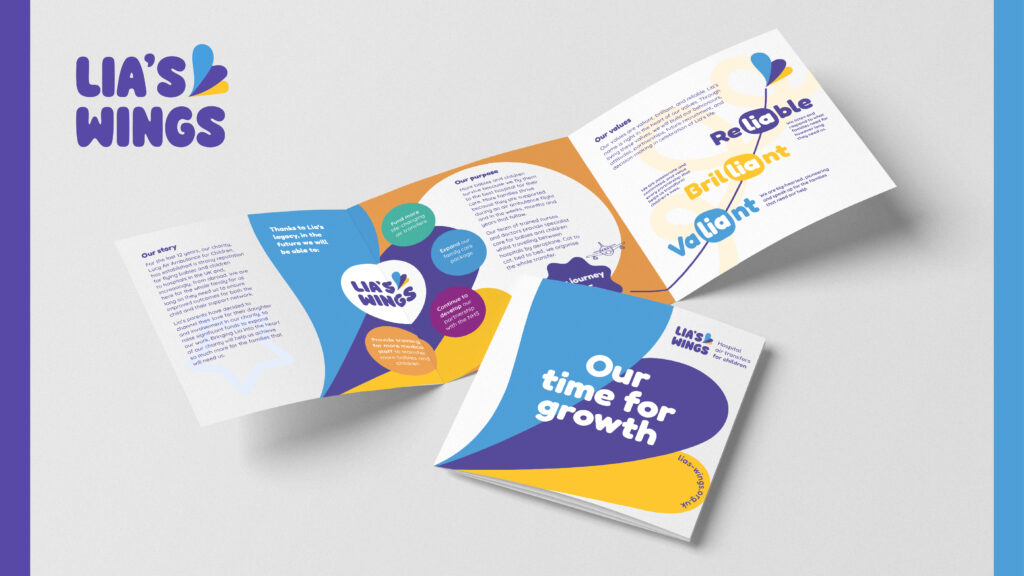
Lia’s Wings brand launch booklet
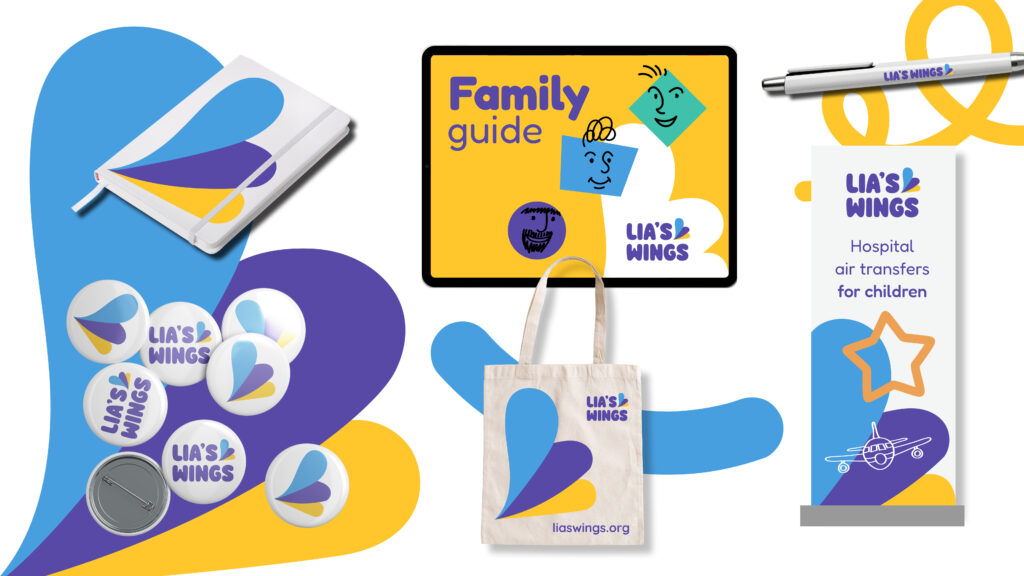
Sample of Lia’s Wings brand merchandise

The new brand reveal next to one of the aeroplanes used to transfer children and babies to another hospital.
Charity branding – a rebrand for Carers Trust CPN
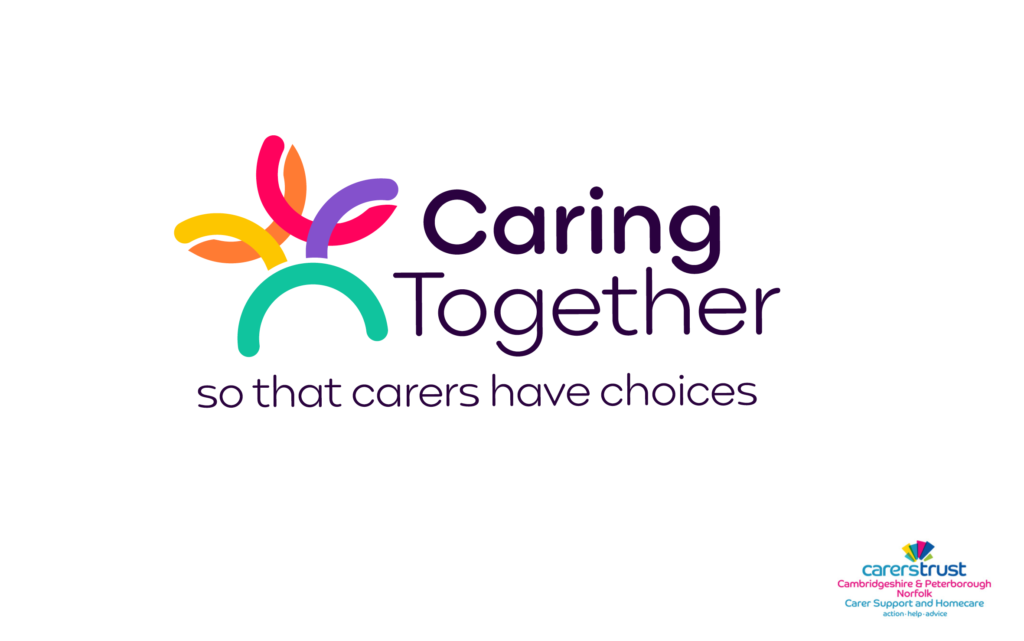
Caring Together – before and after rebrand logos – charity branding
In our latest charity branding project, we have worked with Helen Holden Design on the rebrand of Carers Trust Cambridgeshire, Peterborough and Norfolk. From Monday 15 July, Carers Trust CPN will become Caring Together.
We chose ‘caring’ to bring both the support the charity offers to carers and the services they provide for people who need care under one brand. So not just about carers, but the whole process and business of caring.
‘Together’ emerged from the charity’s long history of collaborating, but also because they bring carers together – together with information and advice, together with services that help and together with each other. Being a carer often means people feel isolated and lonely. So Caring Together is a clear statement about the impact of the support that people can expect from the charity.
A bold new strapline
We paired the new name with a bold strapline ‘so that carers have choices’. As an organisation, Caring Together, places the social model of disability at the very heart of how they deliver information, services and campaigns. Consultation and giving carers choices are central to programme design and delivery.
However, we know that most carers find themselves in caring roles without choosing to be there. The idea of being able to have a choice in anything can feel far removed from daily life. Therefore, the strapline is a clear pledge to carers that Caring Together wants to give them back choices in their lives, and the lives of those they look after.
Finally, we worked with the team to identify three values that underpin both the look and the feel of the new brand and the tone of voice. They arose out of the consultation with carers and from the charity’s previous values statements. They are – inclusive, informed and effective.
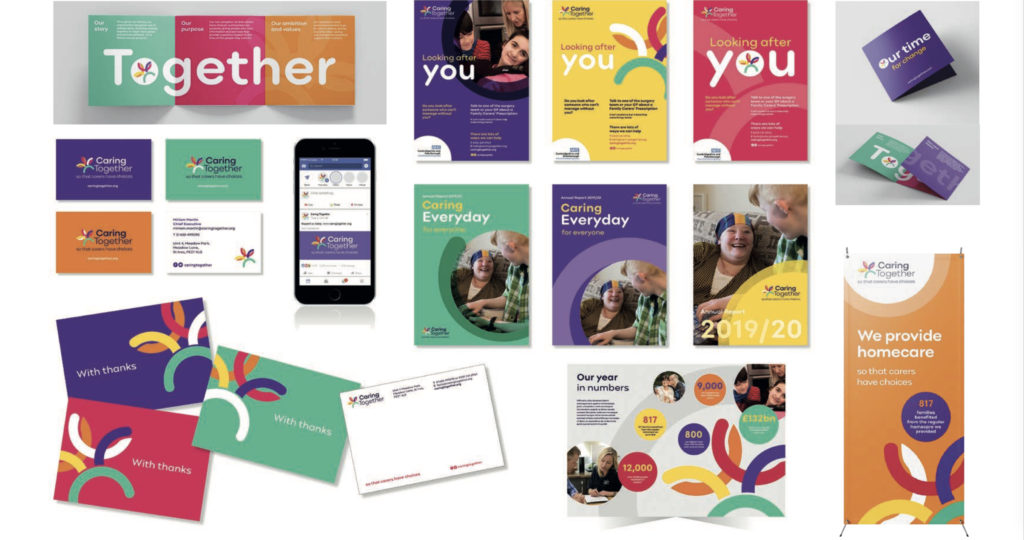
The new charity branding look and feel for Caring Together
More charity branding projects
Here is a selection of rebranding and brand refresh examples produced in collaboration with Helen Holden Design. Follow the link to see more of our charity branding examples.
Please get in touch with hello@redpencil.co.uk if you would like to know more.
Our project management logic model
 We are big fans of the logic model at Red Pencil. This stems from our team’s experience of using logic models to design programmes for international NGOs. We have used logic models to develop fundraising, communications, marketing and digital strategies. We have also used them to design whole-organisation strategies and evaluation frameworks.
Doug, formerly of Engineers Without Borders, described his team and board’s experience of working with us to develop their five-year strategy as:
“Commissioning Red Pencil to support our strategy and governance development turned out to be an extremely shrewd move.” Doug Harper, former CEO
So, when we came to design our own project management approach – we naturally turned to the logic model.
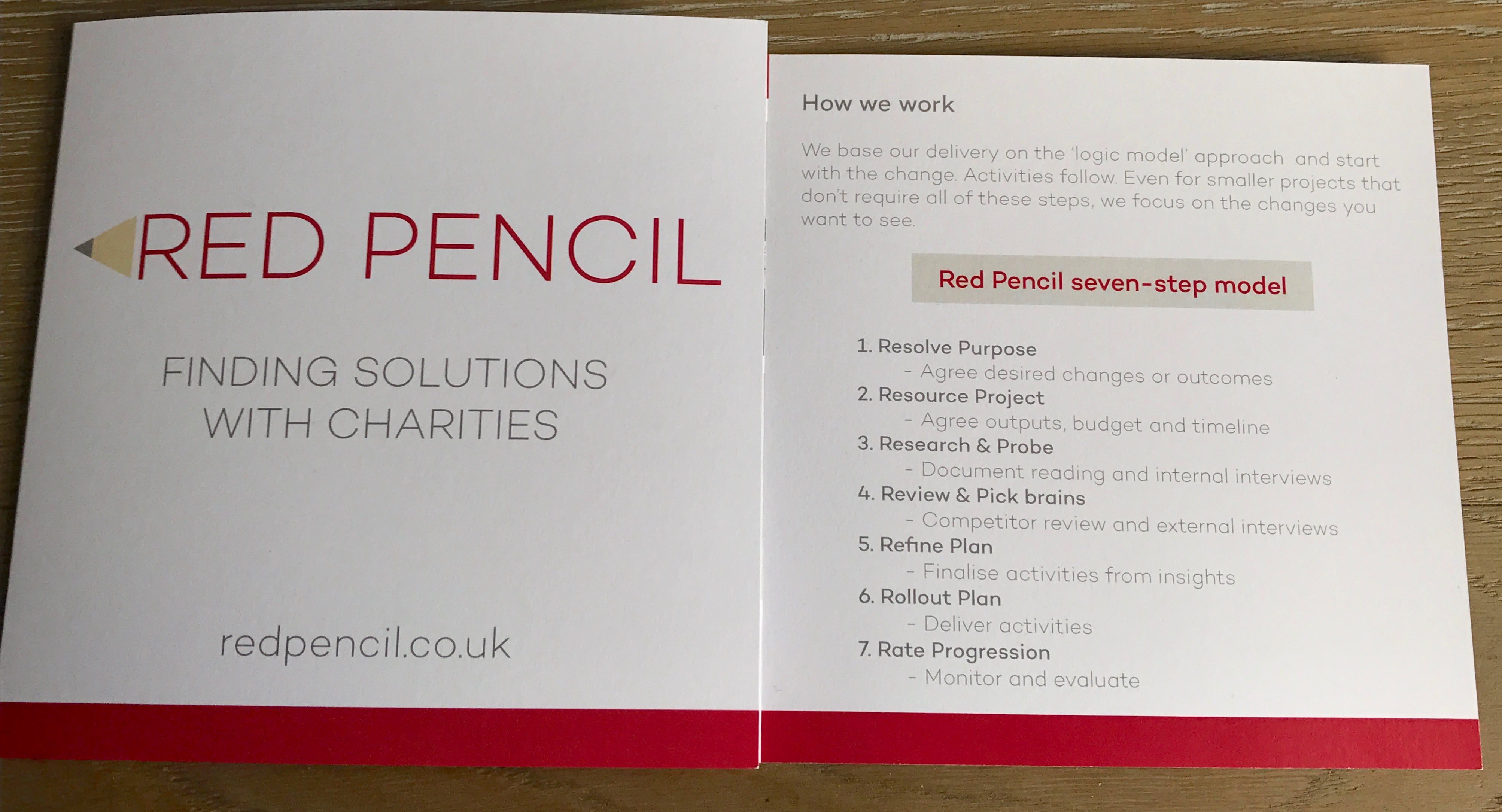
We base our delivery on the logic model approach and start with the desired changes. Activities follow. Even for smaller projects that don’t require all of these steps, we focus on the changes you want to see.
Our Seven-step logic model
- Resolve Purpose – agree the changes (or outcomes)
- Resource Project – agree outputs, budgets (inputs) and timeline
- Research & Probe – document reading and internal interviews
- Review & Pick brains – competitor review and external interviews
- Refine Plan – finalise and deliver activities from insights
- Rate Progression – monitor and evaluate
It is an adaptation, rather than a true reflection, of the logic model but we find it a useful guide through the principle stages of planning and delivering a project.
Anyone spot what we did with our seven-steps, BTW? hello@www.redpencil.co.uk
Carnegie UK Trust rebrand launch
On the anniversary of the death of Carnegie UK Trust’s founder, philanthropist Andrew Carnegie, the foundation has launched a rebrand and new strategy.
I am thrilled to share this news as Helen Holden of HHolden Design and I have been working with Carnegie UK for the last five months. Helen and I work together to bring our respective expertise in visual and verbal branding solutions based on organisational values and audience insights. This has been a great project to work on – not withstanding a few challenges.
Rebranding in a pandemic
It was initially quite daunting to take on rebranding an iconic foundation online. So many of the creative ideas and inspiration during a rebrand happen when you are in a room with other people. Helen and I had to trust that our rebranding methodology would stand up to being delivered entirely through Zoom. We had never tested it in this way before.
Rebranding a wellbeing organisation in the middle of a global pandemic when so much attention was on personal wellbeing, was also ‘interesting’. For Carnegie UK, wellbeing reaches beyond individual wellbeing, although that is important, into understanding wellbeing as a powerful force for changing everyone’s lives for the better. We needed a way to communicate the Carnegie UK concept of wellbeing relating to improving communities and changing societies at a time when daily news bulletins were talking about mental and physical health.
The other challenge we discovered was that while improving wellbeing has been Carnegie UK’s mission for over 100 years, our audience insights research found that not many people knew this. People knew about aspects of Carnegie UK’s work, such as research reports or individual projects, but in isolation from the body of work as a whole. We also found very little understanding that improving wellbeing was the thread that linked everything together.
So, we agreed on a brand strategy to foreground Carnegie UK’s mission.
Collective wellbeing
The concept of ‘collective wellbeing’ was developed through further research and testing to describe Carnegie UK’s more holistic perspective. Collective wellbeing is achieved when social, economic, environmental and democratic wellbeing outcomes are considered together, and given equal importance.
It is an exciting proposition. One which moves us on from the main measures of success being wealth and GDP outputs, to approaches designed to support the positive wellbeing of individuals, communities and society.
Creating a mission-driven logo
Visually, Helen prioritised the foundation’s mission by reversing the traditional order of ‘name before strapline’ in the logo. The mission is placed first and leads the visuals. The organisation name is placed in a supporting role to achieve the mission. The graphic motif in the logo represents the four dimensions of wellbeing in the Carnegie UK’s model of collective wellbeing. While the rounded shapes of the logo and graphics were inspired by the ‘collaborative’ and ‘kind’ values in the new strategy.
It is great to have this rebrand ‘out’ in the public domain. It is here in no small part to the highly collaborative approach Carnegie’s CEO, Sarah Davidson, and Head of Advocacy, Douglas White, took. With pop up appearances from pets, children and partners, the weekly meetings between the four of us were critical in bringing the brand to life.
I am proud to have been part of the team to set Carnegie UK on this next stage of its journey and excited to see how the team develop it.
See examples from the full brand suite and get in touch if you’d like to know more.
How to write a communications strategy using a theory of change
We are big fans of writing communications strategies using a Theory of Change model. It also works for marketing and fundraising strategies as well as whole organisational strategy development!
Theory of Change was first incubated in the international development world where charities to demonstrate clearly and tangibly how their programmes saved lives but these days are used by charities of all types and sizes. There are some great examples of organisations using it very effectively like this one from Young Citizens.
What is a Theory of Change?
A Theory of Change is essentially a diagram that sets out a logical relationship between the inputs (time, money and people available), activities, and impact. Impact is tracked through outputs (the things you can measure) and outcomes (the changes that result). It can also be known as a logic model.

Benefits
For us, there are clear advantages to this approach. It is a great tool for checking whether there is a logical link between resources and impact. Many narrative strategies hide multiple ‘equally important’ outcomes and targets within one document. They do not give teams a clear steer on strategic priorities, nor their responsibilities for delivering those priorities.
To learn more about writing a communications strategy, with an example of a Theory of Change model comms strategy download the Writing a Winning Communications Strategy our free Guide to Writing a Communications Strategy. It is the presentation our director has given at a few training days.
Poorly defined strategies are particularly difficult for communications teams. Communications is both a ‘catch all’ and a ‘difficult to measure’ function. So showing how planned activities should lead to changes in people’s attitudes and behaviours is critically important. There are many extremely busy communications teams who struggle to understand and describe the purpose of the communications they produce. Whereas a Theory of Change approach lines up communications activities with the intended changes in an easy-to-understand diagram.
We’d love to hear what you think of our guide and if you find it helpful.
You may also be interesting in reading our guide to evaluating communications strategies written using a Theory of Change – see Measuring the things that count
Four questions to ask about rebranding
“Successful brands grow. They don’t stand still…
“They take account of the world around them and the changing expectations of their audiences. They evolve, without losing what is in the heart and soul of the organisation.” (Grounds 2005)
Charities are set up to bring about social change – and that takes time. It is therefore very likely, if not a certainty, that all charities will need to consider rebranding.
The issue, particularly for smaller charities, is how can you do this effectively without wasting resources? The answer – is to know what you want and why you want it. This is where the brand management continuum can help. (The brand management activities in the continuum are also listed below as text.)
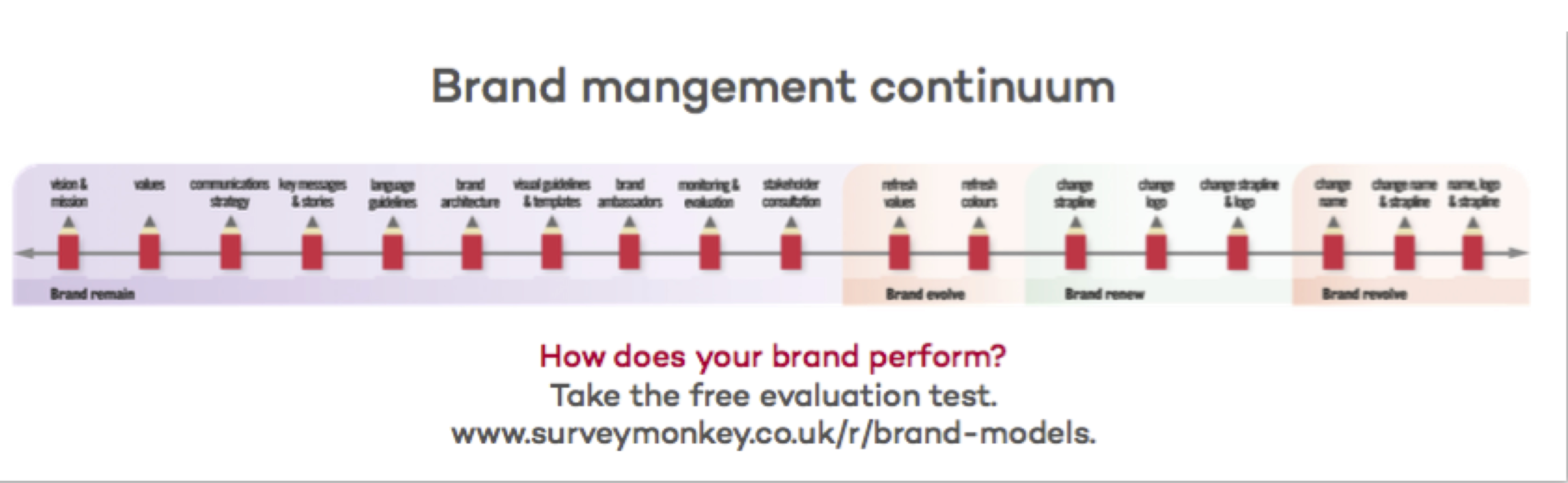
brand management continuum copyright Red Pencil
Four questions to ask
- Is our brand well known and DOES it represent our values?
- Is our brand well known but DOES NOT represent our values?
- Is our brand NOT well known but DOES represent our values?
- Is our brand NOT well known and DOES NOT represent our values?
If you answer ‘yes’ to question 1 then no rebranding is needed. Just the active brand management activities in brand remain to make the most of your brand and know if things change. In fact, you need to be doing all of these things to prepare for a rebrand.
A ‘yes’ to question 2 indicates a mild brand refresh is needed – a brand evolve.
If the ‘yes’ is to question three then you should consider the activities in brand renew.
And, yes, an affirmative answer to question 4 suggests a brand revolve where you pretty much change all of your visual identity.
Where’s your brand?
Find out by taking the free brand evaluation questionnaire at charity brand survey.
So how does this help?
Use the brand management continuum to:
- Make sure you have the brand management basic activities in place.
- Discuss what you mean by rebranding and what you want to change.
- Be clear about the extent of the rebrand and why you are making that decision based on how your brand is viewed (not just on the resources available).
- Write a clear brief to a designer about the activities you want to include in your rebrand.
- Keep the project to brief and stop ‘extras’ creeping in.
List of brand management and rebranding activities
The activities in the brand management continuum have been drawn up from a literature review of studies carried out with large UK charities and then tested with small charities. There were no studies on small charity branding until Red Pencil undertook ours.
Brand remain contains all the building blocks of good brand management:
- Vision and mission
- Values
- Stakeholder analysis
- Communications strategy
- Key messages and stories
- Language guidelines
- Brand architecture
- Visual guidelines and templates
- Brand ambassadors
- Monitoring and evaluation
- Stakeholder consultation
Brand evolve makes moderate changes:
- Refresh values
- Refresh colours
Brand renew makes more extensive changes:
- Change strapline
- Change logo
- Change strap and logo
And you should consider brand revolve when you want to reposition your brand extensively:
- Change name
- Change name and strapline
- Change name, strapline and logo
Let us know how you get on with your rebranding project and get in touch if you need any help.
Using the non-profit portfolio sort
Bumping this post – as I’ve had quite a lot of questions recently about how to prioritise services and products – and this is a good, simple tool to get the discussions started. It is flexible enough to be used across a whole organisation or within different teams. Get in touch if you have any questions – hello@www.redpencil.co.uk
Communications strategy writing using the non-profit portfolio template
Always nice to start the new year with a new client and on very blustery day in the second week of January I headed to very blustery Brighton for our first meeting with Community Works. We are going to be working with them to write a marketing and communications strategy, develop a brand architecture and take photos to start a photo bank.
That first meeting was in preparation for a two interactive staff workshops and the consultation with their members and other stakeholders that will provide the bedrock for writing the communications strategy. The following week it was back to run the first of those workshops to look at the context for Community Works using a PEST analysis and then to analyse the strengths and weaknesses within the team to make the most of the opportunities and address the threats using a TOWS analysis (a variation on the more common SWOT analysis). We also used the 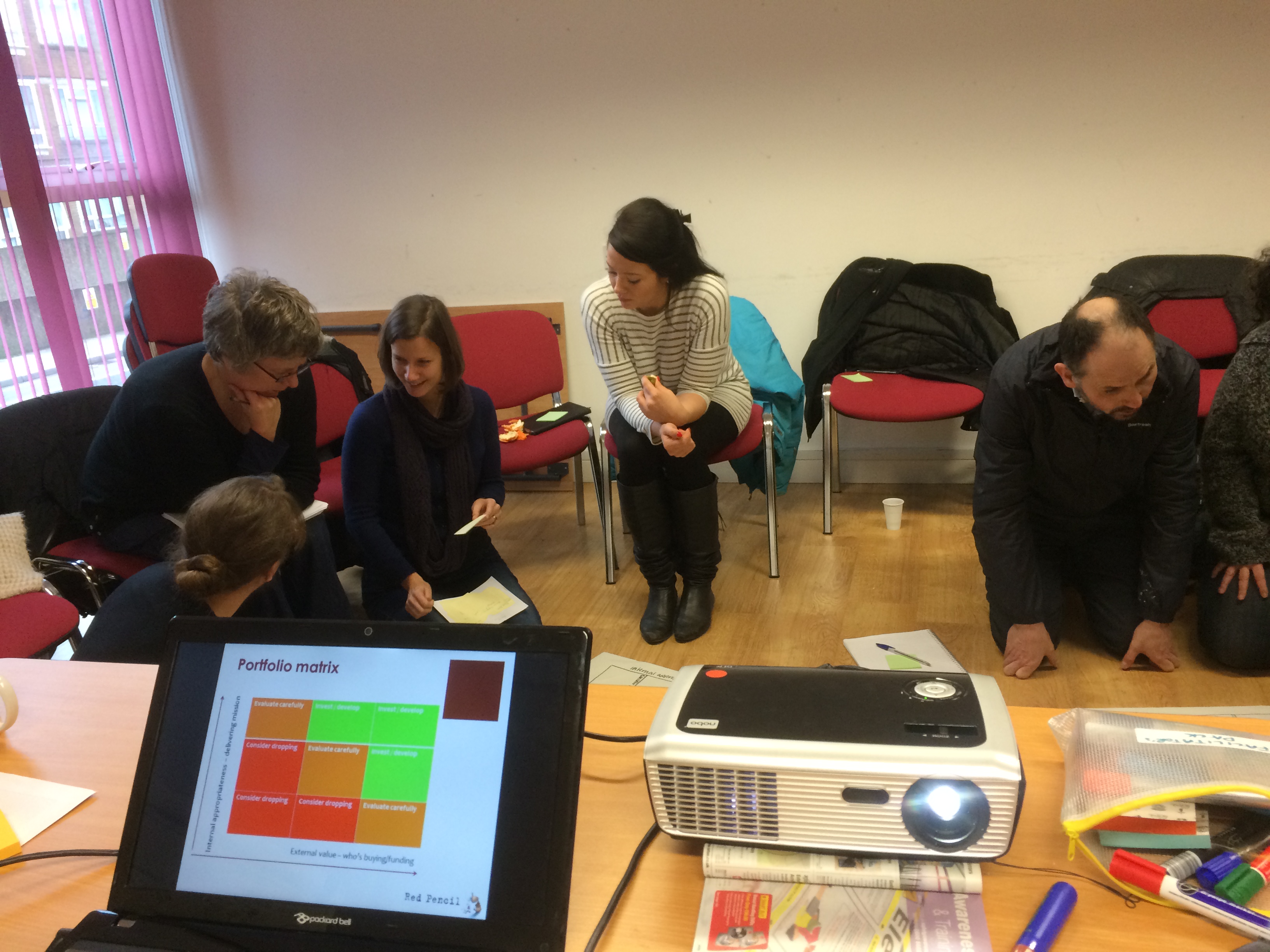

communications strategy – portfolio sort – getting started
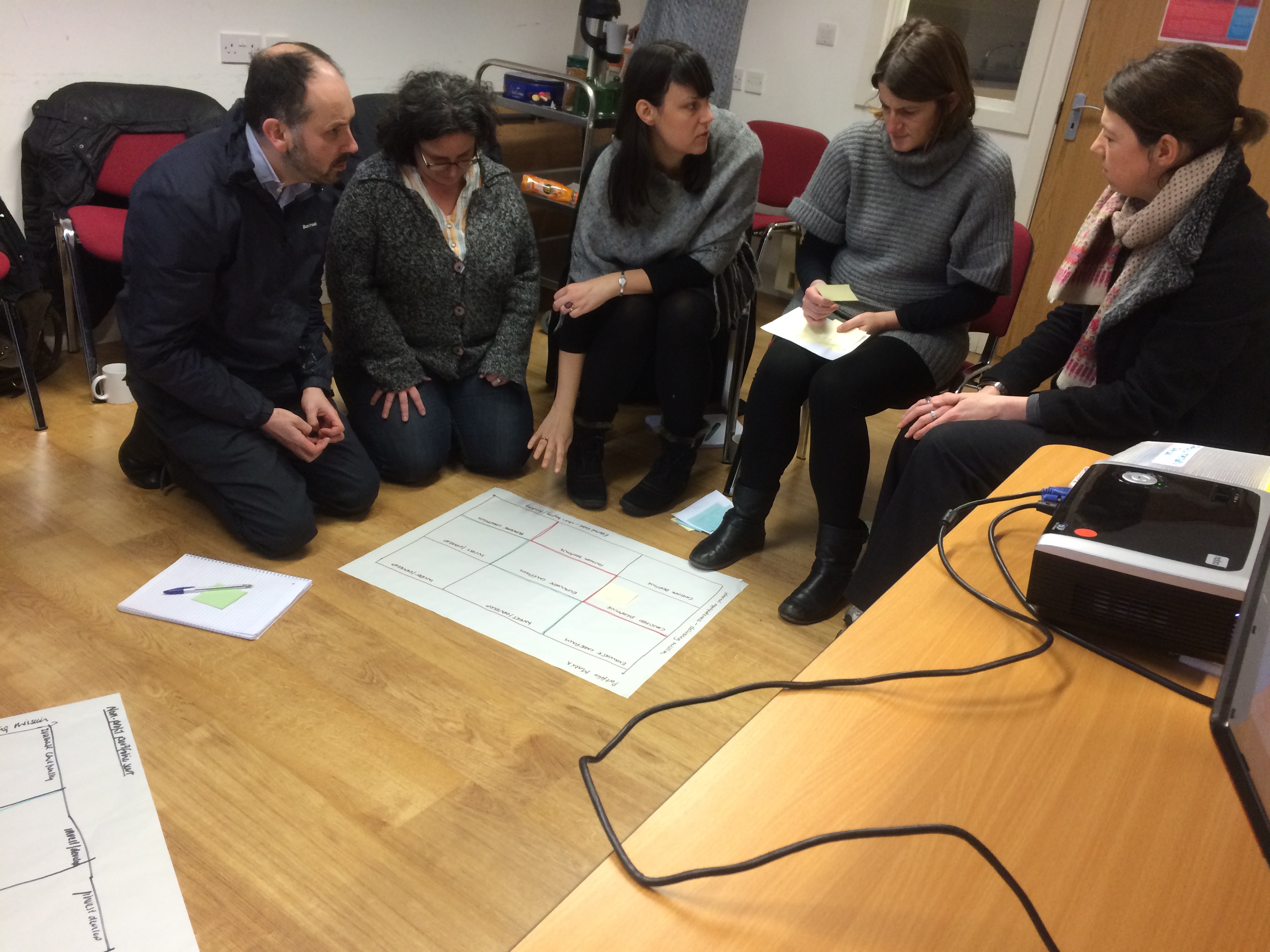
communications strategy – non-profit portfolio sort – getting started
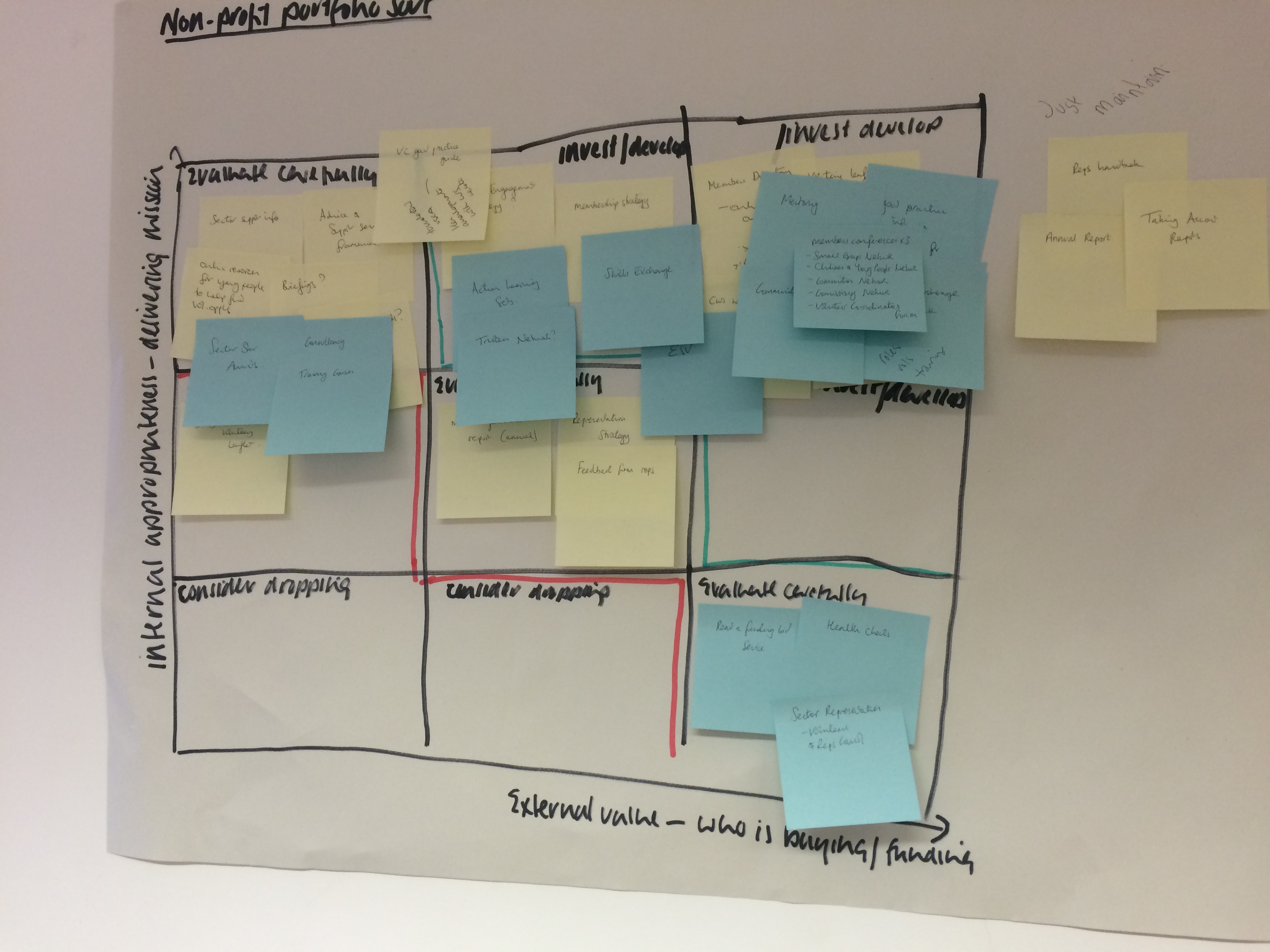
communications strategy – non-profit portfolio sort – all filled in and finished
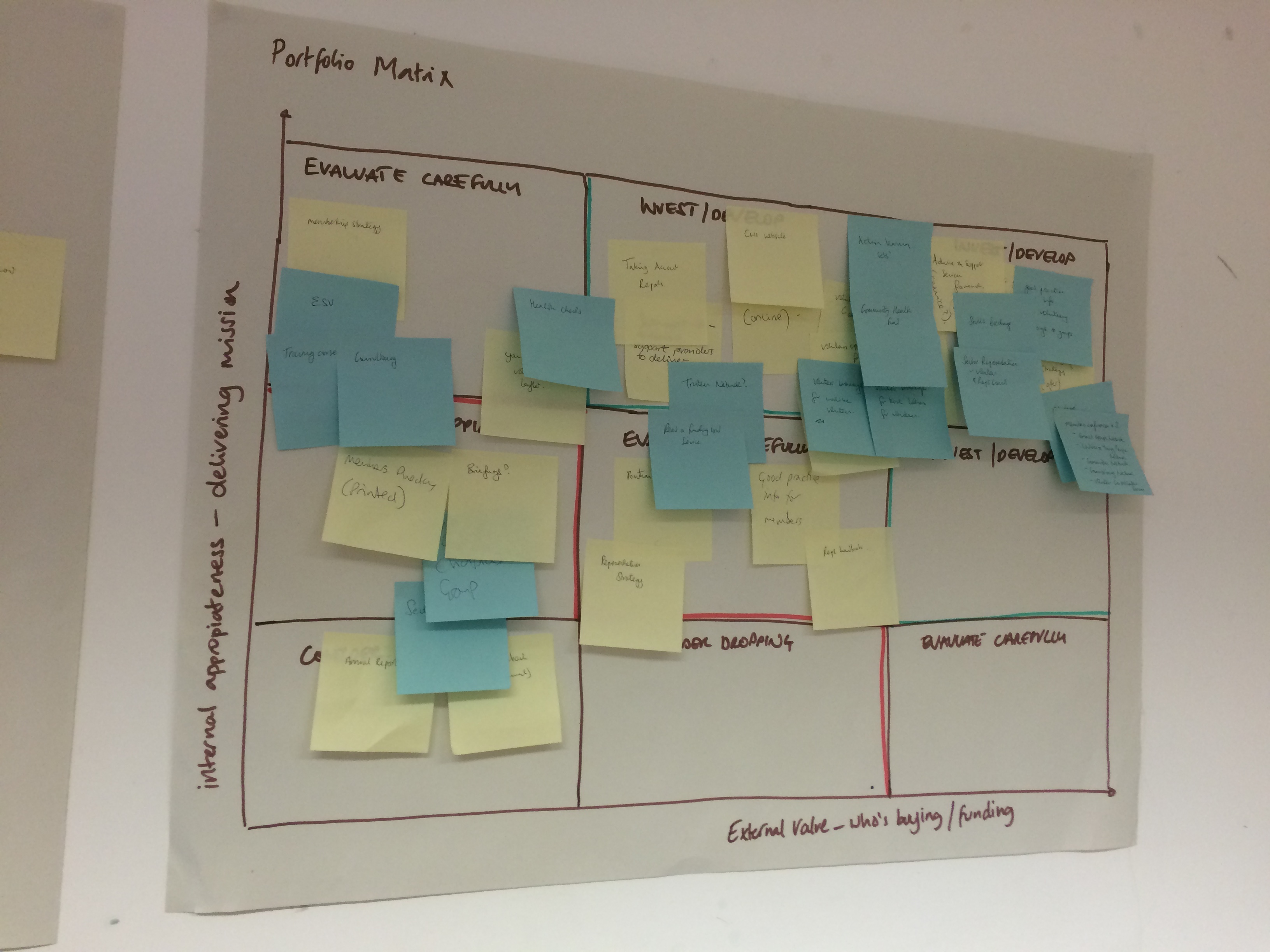
communications strategy – non-profit portfolio sort – all filled in and finished
How to measure the things that matter
Evaluating communications

Start with the wider picture rather than what you are doing when evaluating communications
Four years ago, at the first workshop I ran at the DSC charity writing and communications training days a participant called Rose asked me:
When evaluating communications, how do you know you are measuring the things that matter rather than just measuring the things you expect to see?
It was a good question. I’m sure many communications people have asked the very same question. It gave me pause for thought.
Her question came back to me when planning this year’s evaluating communication workshop because what I should have said loudly and clearly is – to start with the ‘big picture’.
Or the most important ‘what’ questions. What:
- is our vision?
- are the changes are needed to help achieve our vision?
- actions (knowledge, attitude and behaviours) do we need people to take to make these changes?
- are we doing to get people to take these actions?
Followed by the critically significant ‘which’ question. Which:
- of these things are to do with communications?
Starting with the change
In other words, you start from what you are trying to change. The activities and actions (knowledge, attitudes and behaviours) you measure flow from that.
In the international NGO world and some other charity sectors, this is known as ‘top down planning’. It’s good stuff – and it works.
Rose’s question was initially tricky to answer, because all too often communications planning and evaluation start at the ‘bottom’ – with the focus on ‘what we are doing’ rather than asking ‘why’ and ‘how do we know if it’s working’?
When you start by planning communications evaluation from the ‘bottom up’ you can miss the bigger goals. Almost certainly you end up measuring the things you expect to see rather than progress towards the changes needed to achieve your vision – the things that matter.
To find out more you can read slides from that workshop I ran at a Directory of Social Change training day on Evaluating Communications. You can download the slides here.
I also ran a workshop on Writing a Winning Communications Strategy which you may also find useful. You can download that presentation here.
« Older Entries